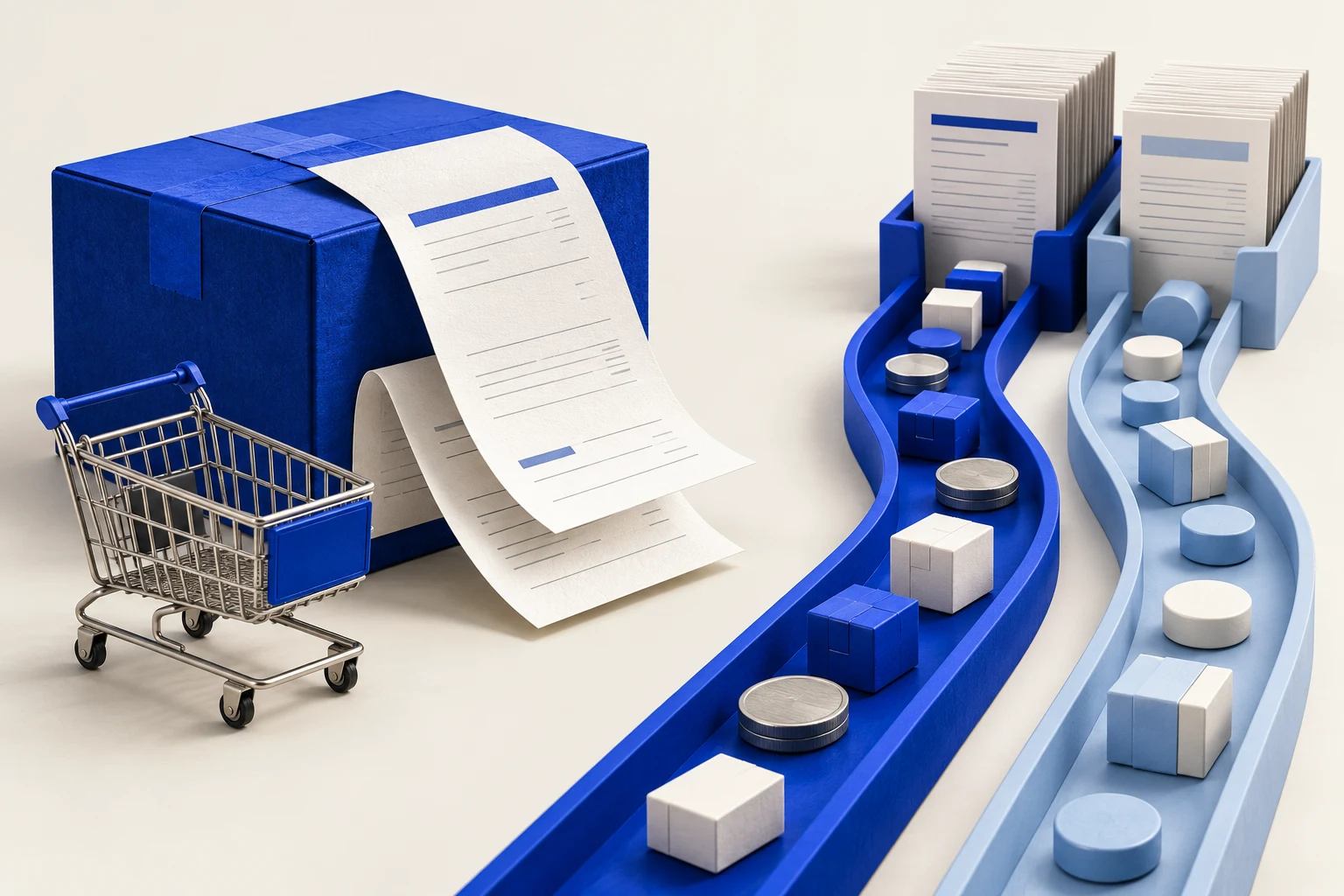
For online sellers in Brazil, tax reform is also an operational project. The store, tax invoicing software, ERP and payment providers need consistent information throughout the transition.
Trying to understand the new tax on online stores? Online sellers often ask about it, but Brazil's dual VAT consists of two taxes: IBS and CBS. This article on tax reform for online stores covers the main points to prepare your e-commerce operation.
This guide addresses Brazilian consumption taxes. It helps you organize questions for your accountant and technology team, without promising a single tax rate or automatic savings for every business.
IBS and CBS in e-commerce: what is dual VAT?
The model combines a federal contribution, CBS, and a tax shared by states and municipalities, IBS. CBS replaces PIS and Cofins; IBS gradually replaces ICMS and ISS. Receita Federal: understanding the reform ↗
“Dual” describes these two components. Retailers need to connect customer records, sales, tax documents and receipts. Simply renaming a tax in the system does not address the full process.
What does the timeline look like?
- 2026
Test year
Test rates of 0.9% for CBS and 0.1% for IBS. These percentages do not represent the store's final tax burden.
- 2027–28
CBS replaces PIS and Cofins
The new federal phase begins; IBS remains at a transitional level.
- 2029–32
Both models coexist
IBS gradually increases as ICMS and ISS decrease.
- 2033
Fully implemented model
IBS completes the replacement of ICMS and ISS.
Summarized timeline. Receita Federal timeline ↗
The joint statement provides exemption subject to compliance with applicable ancillary obligations, and also for taxpayers without a defined ancillary obligation. Documents, technical notes and effective dates must be checked for each case. RFB and CGIBS guidance ↗
How does tax reform affect an online store?
1. Destination and record quality
For remote sales of tangible goods, the general rule considers the final destination indicated by the buyer, subject to statutory exceptions. Delivery addresses and tax information need to be consistent. LC 214/2025, art. 11 ↗
Review how addresses move between checkout, ERP and invoicing. Test address changes and in-store pickup with your accountant, documenting the approved treatment for each scenario.
2. Pricing and tax credits
Under the regular regime, IBS and CBS credits depend on legal requirements and applicable exceptions. Do not treat every expense as an automatic credit. LC 214/2025, arts. 47 e 48 ↗
Run simulations by product family, channel and buyer profile. Record costs, selling expenses, taxes and margins separately. Ask your accountant to validate the assumptions before updating published prices.
3. Marketplace and direct sales
The law assigns responsibilities to digital platforms in specific circumstances. Selling through a marketplace does not automatically remove all of the seller's obligations. LC 214/2025, art. 22 ↗
Map who reports, issues documents, receives payments and reconciles each channel. Preserve the marketplace order identifier through to finance, including cancellations, returns and adjustments. This traceability helps identify discrepancies without re-entering data.
4. Split payment and cash flow
Split payment provides for tax segregation and collection during financial settlement, with gradual implementation defined by joint regulations. Do not assume universal, immediate application to every Pix or card transaction. LC 214/2025, arts. 31 a 35 ↗
Prepare reconciliation to distinguish sale value, provider fees, segregated taxes and net receipts. When forecasting working capital, avoid treating amounts allocated to taxes as available cash to finance inventory.

Do Simples Nacional businesses have to leave?
Simples Nacional remains available. A business may remain in Simples and opt for regular IBS and CBS assessment outside the DAS payment. The choice has its own rules, deadlines and effects; it does not automatically move the entire business to another regime. CGSN: adapting Simples to the reform ↗
Compare scenarios with your accountant: purchasing mix, consumer or business sales, margins and the cost of managing each option. Check the current election calendar; a closed application window should not be treated as still available.
This article does not estimate a universal tax burden. The result requires checking products, operations, tax framework, eligible credits and current rules. Date your simulations and document assumptions instead of applying a reference percentage indiscriminately to the catalog.
What to prepare now
For technology and management planning, start with six small, verifiable deliverables:
- System inventory. List your platform, ERP, tax invoicing software, marketplaces and payment providers. Assign an owner to each integration.
- Reviewed records. Identify products with incomplete tax classifications, conflicting information or rules not yet validated by your accountant.
- Tax update plan. Confirm with suppliers which versions and technical notes apply to the documents your company issues.
- End-to-end testing. Simulate purchases, invoicing, partial payments, cancellations and returns in a test environment, with approval from those responsible for tax compliance.
- Order reconciliation. Preserve references between sales, invoices and settlements. Create a discrepancy queue with a reason and an owner.
- Decision records. Keep assumptions, dates, test evidence and accounting guidance. Define how new rules will be reviewed and published.
A well-planned integration lets you follow an order and identify where data stopped flowing. At RAQO, this starts with the company's real processes and the technical capabilities of the systems involved.
EXPLORE OUR SERVICEE-commerce connected to ERP ↗Informational content reviewed on November 1, 2026. Application depends on the business and regulations in force. Validate tax decisions with your accountant. Site demos are fictional and do not calculate taxes.