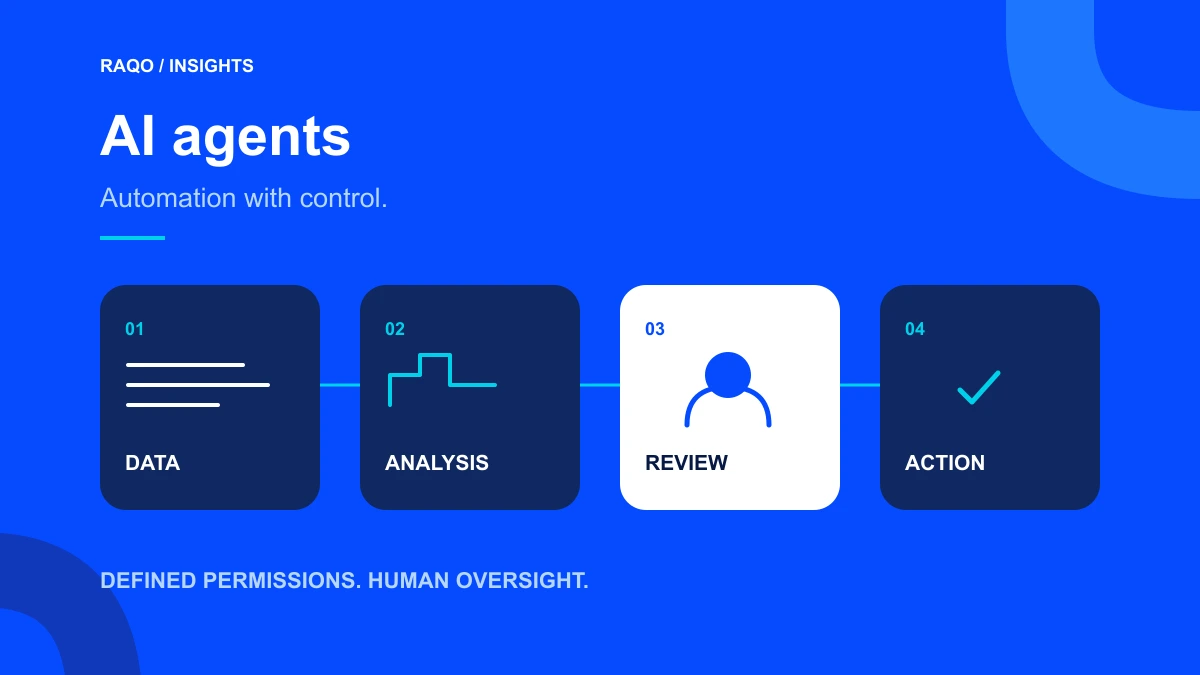
Answering a question and carrying out a system action involve different responsibilities. When AI starts consulting records, preparing documents or proposing changes, its scope of autonomy must be explicit.
The 2026 discussion goes beyond chatbots
Recent NCSC and Canadian government guidance emphasizes bounded scope, controlled permissions and oversight proportionate to the consequences of actions. Adopting an agent does not remove accountability for the underlying process.
NCSC — Managing the cyber risk of agentic AI ↗Governo do Canadá — Guide on the Use of Agentic Artificial Intelligence ↗Choose a small, verifiable task
For project planning, we favor an observable deliverable: classify a request, extract document fields or draft a customer history summary. Define the expected output and who will assess quality before development.
Consider a fictional distributor receiving orders by email. An agent could organize items and prepare a draft for review, while a responsible person retains commercial approval. This lets the team assess useful work without giving the first pilot authority to change prices or confirm sales.
Separate reading, preparation and execution
We propose three levels in the specification: read authorized information, prepare an action for review and execute an allowed change. Moving between levels should depend on the project, tests and consequences of an error.
For a sales order, identifying a customer should not automatically mean modifying customer records. Document which fields may be proposed, required information and who accepts the change. A task without enough information should return to the team with its missing inputs identified.
Turn boundaries into acceptance tests
This operational checklist is RAQO’s proposal for discussing a pilot with business and technology owners.
- Define one task and the systems it needs.
- Use representative test data without exposing unnecessary information.
- Document allowed actions and changes requiring approval.
- Test missing information, conflicting instructions and unavailable tools.
- Record the proposal, human decision and operational result.
- Agree how to pause the pilot and handle unexpected actions.
Measure outcomes before increasing autonomy
Track review time, fields corrected by staff, completed tasks and human escalations. Compare against a sample handled by the current process. Well-written responses alone do not demonstrate a better workflow.
Expand one task class at a time. If automation creates more work downstream, revise it first. RAQO integrates AI with systems and operational rules, aiming for verifiable usefulness rather than unrestricted autonomy or automatic staff replacement.
Frequently asked questions
Are AI agents and chatbots the same?
A chatbot may only converse. An agent may be configured to use tools and perform task steps. Behavior depends on the implementation.
Must every action require human approval?
That depends on process rules and impact. The scope should distinguish permitted tasks, required reviews and out-of-bounds actions.
Official sources
NCSC — Managing the cyber risk of agentic AI ↗Governo do Canadá — Guide on the Use of Agentic Artificial Intelligence ↗Accessed November 2, 2026. Project checklists and examples in this article are RAQO editorial proposals.