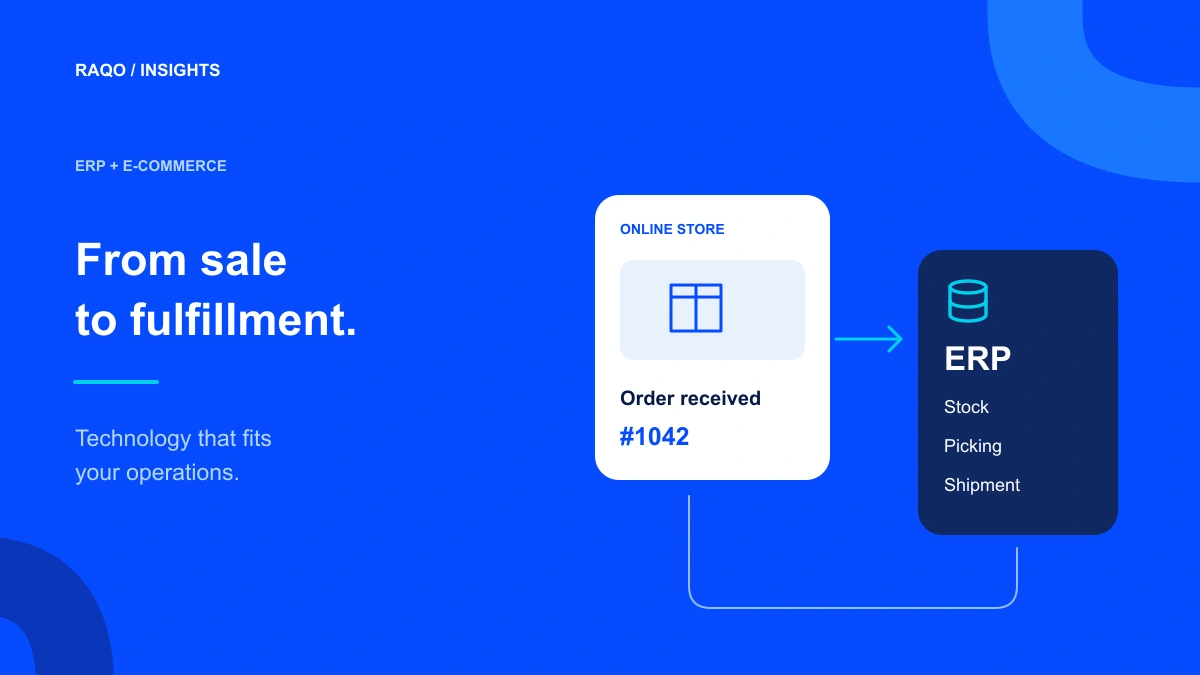
An online sale still has to reach the team fulfilling it. Without the right information exchange between the ERP and store, employees copy records and check stock manually. Start an integration project by defining the rules for that exchange.
What does ERP and store integration mean?
AWS explains APIs as mechanisms for software components to communicate through definitions and protocols. An e-commerce integration can use this mechanism to exchange ERP data, subject to the capabilities each platform offers.
AWS — O que é uma API? ↗Assign an owner to each data field
Decide where records are maintained before connecting tools. Will the ERP own the product catalog? Who changes prices? When does an order reserve stock? Unrestricted editing in both places can create conflicts.
RAQO recommends mapping each information type, source, destination, update trigger and exception owner. Confirm API availability, permissions, limits and commercial terms with providers.
- Products: identifiers, variants, units and sale status.
- Prices: lists, promotions, validity and channel rules.
- Inventory: availability, reservations and location.
- Orders: items, customer, delivery and source identifier.
- Operations: financial confirmation, picking, shipment and cancellation.
Physical, reserved and available stock differ
Consider a fictional retailer with ten units, three already committed to orders. Showing ten available across every channel could create sales the team cannot fulfill. The integration must implement the company’s availability rule.
Define what happens during an outage too. Staff should see when stock was last updated. Depending on risk and operating rules, some products may need to be paused or a buffer applied. Agree these decisions within the project.
Plan the entire order lifecycle
Sending a sale to the ERP is only one step. Link the identifiers used by both systems and follow the stages the team actually needs. Payment confirmation, for instance, is distinct from shipment confirmation.
Simulate unconfirmed payments, cancellation after reservation, returns and address changes. Assign a rule and owner to each. Where automation is unavailable, make the manual review visible in the work queue.
Avoid duplicate orders and invisible failures
Our implementation proposal includes recognizing repeated notifications, recording delivery attempts and supporting controlled retries. A repeated event should be matched to the existing order before another is created.
An operational view should expose the last update, pending reason and next step. “Integration active” does not explain why an order is stuck. Staff need to locate the exception and know whether to resolve it or request support.
A rollout checklist
Validate a small selection of products and orders first. Use test data and inspect results on both sides with the people handling fulfillment and customer support.
- Compare identifiers, variants, values and units.
- Test purchase, reservation, payment, shipment and cancellation.
- Simulate repeated events and connection outages.
- Recover a pending order.
- Define owners, alerts and support procedures.
- Agree which operational indicators to track after launch.
Frequently asked questions
Can every ERP be integrated?
Feasibility depends on capabilities, documentation, permissions and access terms. Assess these before promising an integration.
Will updates always happen in real time?
Not necessarily. Timing depends on architecture, available events and provider limits. Include the expected update interval in scope.
Must every product be created again?
Not automatically. First assess data quality, identifiers and available import or synchronization methods.
Official sources
AWS — O que é uma API? ↗Accessed November 3, 2026. Project checklists and examples in this article are RAQO editorial proposals.