An off-the-shelf system can serve a standardized workflow well. Custom development becomes worth exploring when important business rules remain in spreadsheets, messages or manual checks. Start with the process that needs to work, rather than the number of screens.
How do off-the-shelf and custom systems differ?
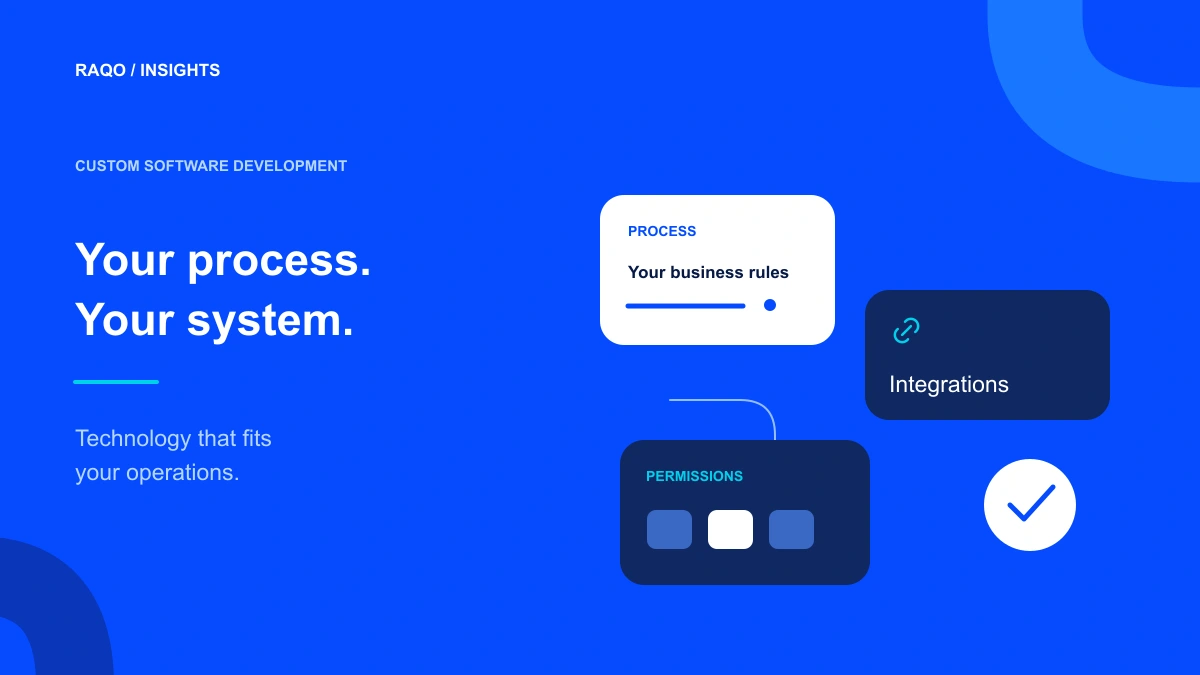
An off-the-shelf product comes with defined capabilities and rules, within its available configuration options. A custom project defines workflows, permissions, integrations and interfaces around requirements agreed with the client.
Neither choice solves everything automatically. A packaged product may require operational adjustments; custom software needs priorities, validation and maintenance. A hybrid approach can keep an effective ERP and add a portal, app or module for a specific need.
When should you consider custom development?
RAQO recommends looking at handoffs where information loses context. Is the same order entered twice? Does an approval depend on finding someone in a messaging app? Does reporting require merging several spreadsheets? These are useful starting points for scoping the problem.
Consider a fictional repair business whose system records service jobs while quotation approval and parts reservation happen separately. A project could connect these stages with ownership and history, without replacing the entire software environment.
- Important business rules missing from the current product.
- Repeated work between tools that could exchange information.
- A dedicated area for customers or partners.
- Permissions and approvals that need clearer control.
- A specific experience for employees or customers.
What determines the cost of custom software?
Scope drives the estimate. Integrations, user roles, rule complexity, data migration, security requirements and support arrangements all affect the work. A screen list alone is not enough to compare proposals reliably.
Ask for a breakdown of initial development, third-party services, infrastructure, rollout, support and later changes. For monthly payments, clarify inclusions, duration, continuity and out-of-scope requests. Ongoing operating costs matter alongside the initial investment.
What should a proposal clarify?
Describe an initial delivery that people can use and assess. For each workflow, specify who starts it, what information is required, who approves it and what confirms completion. A demonstration supports shared understanding but does not replace acceptance criteria.
- First-version scope and later phases.
- Responsibilities for data, access, infrastructure and integrations.
- Delivery milestones and expected client involvement.
- Testing, training and launch criteria.
- Source code, documentation, data export and contract exit terms.
Security belongs in the development scope
OWASP ASVS provides requirements for developing and verifying web application security. It can inform technical discussions about relevant controls. Referencing it does not establish certification or prove every requirement has been verified.
OWASP — Application Security Verification Standard ↗How can you start with a focused delivery?
Choose a workflow with a clear beginning and end. Record current effort, common failures and the expected outcome, then validate how the proposed system will handle that work.
RAQO’s initial discussion focuses on understanding operations and defining a useful first phase with room to evolve. Bring a concrete difficulty the team recognizes as a priority.
Frequently asked questions
Do I need to replace my ERP?
Not necessarily. Modules, portals and apps can be considered if the ERP provides the required integration capabilities.
Does custom software always take longer?
Timing depends on scope, integrations and validation. Compare equivalent requirements and deliveries rather than generic speed claims.
Can I start with a small feature set?
Yes. An initial version can cover one complete priority workflow, with later phases planned separately.
Official sources
OWASP — Application Security Verification Standard ↗Accessed November 3, 2026. Project checklists and examples in this article are RAQO editorial proposals.